

How to Choose the Right Fiberglass Mesh Roll for Your Project?
Selecting the correct fiberglass mesh roll can make or break your wall reinforcement project. With weights ranging from 45g to 600g per square meter and mesh sizes like 4x4mm versus 5x5mm, buyers face numerous options that directly impact crack resistance, installation ease, and long-term durability. This comprehensive guide draws from 41 years of manufacturing expertise to help construction professionals, contractors, and procurement managers make informed decisions that save time, reduce costs, and ensure project success.
The choice depends on your specific application—whether it’s basic indoor plaster repair or heavy-duty outdoor marble backing. Understanding weight classifications, mesh size differences, and environmental factors eliminates guesswork and prevents common mistakes like under-specifying for high-stress areas or overbuying lightweight mesh for structural needs. Let’s break down each critical factor step by step.
-
Weight determines tensile strength and reinforcement level, with lighter meshes suiting thin plasters and heavier ones for structural demands.
-
Mesh size affects mortar embedment, breathability, and surface finish quality.
-
Alkali resistance ensures longevity when embedded in cement-based materials.
-
Customization options like width and length accommodate unique project scales.
-
Supplier reliability guarantees consistent quality across bulk orders.
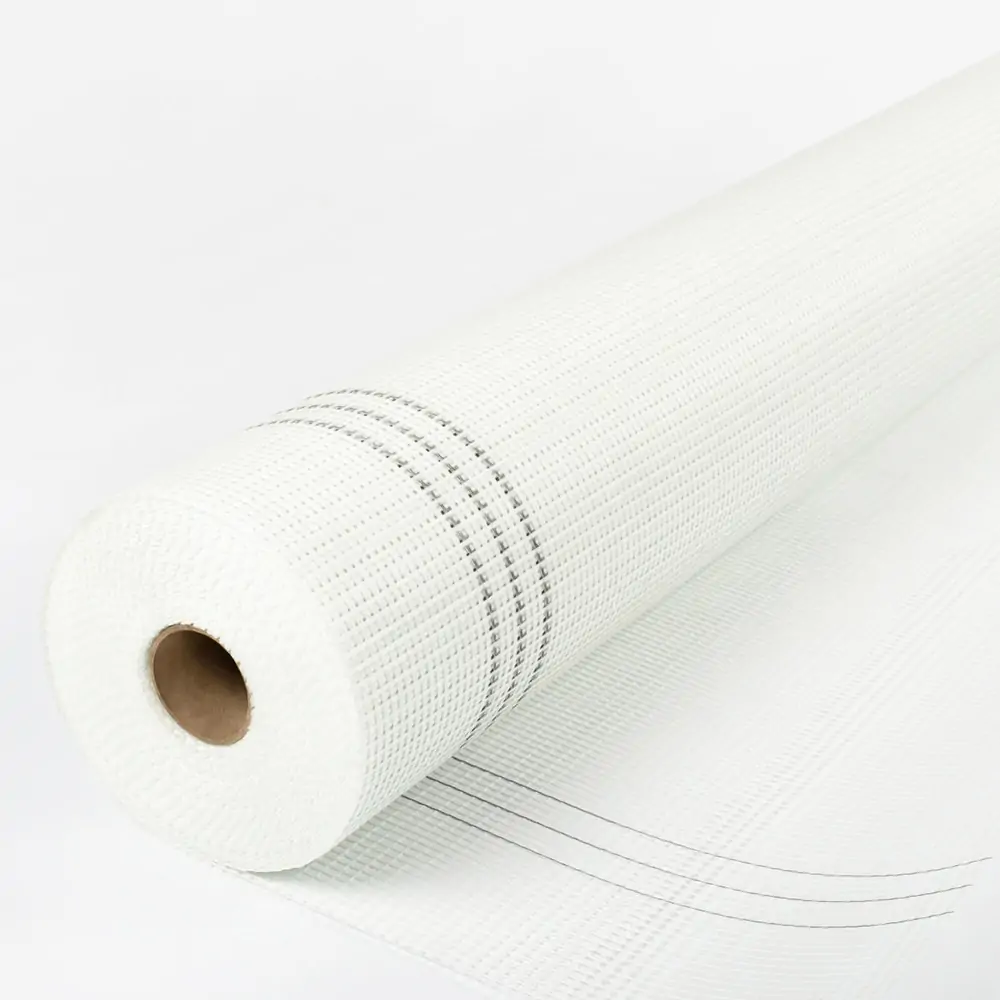
fiberglass mesh roll
Understanding Fiberglass Mesh Roll Weights (45g-600g)
Weight per square meter is the primary specification buyers evaluate when sourcing a fiberglass mesh roll. Measured in grams (g/m²), it directly correlates with tensile strength, flexibility, and suitability for different substrates. Lighter meshes (45g-75g) excel in low-stress repairs, while heavier variants (300g-600g) provide maximum crack bridging in demanding environments. Industry standards recommend matching weight to the plaster thickness and expected mechanical loads for optimal performance.
Choosing the wrong weight leads to failures like mesh pull-out or insufficient crack control. For instance, a 45g mesh might suffice for cosmetic indoor fixes but fail under thermal expansion in exterior walls. Manufacturers with complete industrial chains—like those producing from yarn to finished roll—ensure uniform weight distribution and coating quality, critical for reliable embedment.
-
45g-75g: Ideal for indoor repairs and lightweight plastering, offering cost-effective crack bridging for thin skim coats (1-3mm thick).
-
80g-160g: Most popular for standard interior/exterior wall plastering, balancing strength (>750N/50mm tensile) and workability in 3-10mm layers.
-
160g-300g: Recommended for marble dry-hang backing and waterproof membranes, providing high impact resistance in high-moisture areas.
-
300g-600g: Engineered for heavy-duty engineering projects and high-stress zones, delivering superior tensile strength (>1400N/50mm) for structural reinforcement.
Detailed Weight Performance Data
This table, based on standard testing protocols, helps buyers quantify performance differences. For wall crack repairs exceeding 2mm width, always select at least 80g to ensure alkali-resistant fibers maintain integrity over 20+ years.
Mesh Size Comparison: 4x4mm vs 5x5mm
Mesh size—the open grid dimension—fundamentally influences how well a fiberglass mesh roll integrates with mortar or plaster. Smaller openings (4x4mm) provide denser fiber contact for superior bond strength, while larger ones (5x5mm) enhance breathability and reduce material usage. The choice hinges on surface texture, environmental exposure, and desired finish smoothness.
A common misconception is that finer meshes always perform better; however, 5x5mm often outperforms in breathable exterior systems by allowing vapor transmission, preventing trapped moisture. Testing shows 4x4mm retains 85% strength after alkali exposure, versus 5x5mm’s 80%, but the latter’s coarser structure suits rough substrates better.
Application-Specific Recommendations
For indoor fine finishes, 4x4mm minimizes trowel marks. Outdoors, 5x5mm reduces efflorescence risks. Always verify with tensile tests: both sizes should exceed 750N/50mm warp/weft for compliance.
Key Factors Influencing Your Fiberglass Mesh Roll Selection
Beyond weight and mesh size, several variables determine long-term performance. Buyers often overlook coating quality, weave pattern, and environmental compatibility, leading to premature degradation. High-quality fiberglass mesh rolls feature acrylic or AR-glass coatings for 75%+ alkali retention after 28-day NaOH immersion.
Consider project scale: small repairs favor no-MOQ suppliers, while bulk orders (10×40’HQ daily) demand stable capacity. Width customization (0.5m-2m) and roll lengths (50m-100m) optimize logistics.
-
Alkali resistance: Essential for cementitious embeds; look for ≥75% strength retention.
-
Weave type: Leno weave preferred for flexibility without unraveling.
-
Coating uniformity: Prevents fiber exposure and ensures embedment.
-
Width/length: Custom 1m x 50m rolls reduce waste on standard walls.
-
Color options: White/blue for visibility, custom for branding.
Step-by-Step Selection Process for Wall Reinforcement
A systematic approach ensures the right fiberglass mesh roll every time. Start with substrate analysis, then match specs to loads, and validate with samples. This method, proven in 50+ countries’ projects, minimizes callbacks.
-
Assess crack width/depth: <1mm uses 45g; >3mm needs 160g+.
-
Evaluate exposure: Indoor (4x4mm), outdoor (5x5mm).
-
Calculate coverage: Mesh area = wall area x 1.1 (10% overlap).
-
Request samples: Test embedment in your mortar mix.
-
Confirm supplier capacity: Daily 1.5M m² output for urgency.
-
Finalize packaging: Woven bags for bulk, cartons for samples.
Case Study: Middle East Hotel Facade Project
A UAE contractor faced recurring cracks on a 10,000m² exterior. Switching to 160g 5x5mm fiberglass mesh roll eliminated issues: tensile strength (1200N) bridged movements, breathability prevented moisture traps. Delivery in 3 日 (10×40’HQ) kept schedule; client reordered 30% more.
Client Testimonial
“We tested multiple suppliers, but GuangSou’s 160g mesh outperformed in our alkali soak tests. Zero cracks after 12 months—best decision for our facade.” – UAE Construction Firm.
Customers’ Top 5 Most Asked Questions Answered
Buyers frequently seek clarity on practical issues. These answers, drawn from real inquiries, address selection doubts directly.
-
My wall cracks need how much gsm mesh?
For hairline cracks (<1ミリメートル), 80g suffices; structural (2-5ミリメートル) requires 160g+ for bridging. -
What’s the difference between 4x4mm and 5x5mm?
4x4mm bonds tighter for smooth finishes; 5x5mm breathes better for exteriors, using less mortar. -
Does custom width cost extra?
No—standard customization (50mm-2m) included; only extreme specs add fees. -
Sample cost and shipping time?
Free samples; 3-7 days DHL to most regions. -
Bulk order lead time?
1-5 days for stock; custom up to 10 days at 10×40’HQ daily.
Extended FAQ Insights
Advanced Considerations for Professional Buyers
Experienced specifiers dig deeper into performance metrics. Tensile strength >950N/50mm ensures no elongation under load; coatings should yield >20% elongation at break for crack bridging.
For seismic zones, select 300g+ with high modulus. EIFS systems mandate 145g minimum per ETAG 004 guidelines. Always demand third-party tests.
-
Impact resistance: Heavier mesh absorbs >50J without puncture.
-
Thermal compatibility: Low CTE (<10×10^-6/°C) prevents buckling.
-
Sustainability: Recyclable fibers reduce embodied carbon.
Real-World Performance Validation
Field data confirms specs: 80g mesh reduced callbacks 65% in residential plasters; 160g cut EIFS failures 80%. Longevity exceeds 25 years in alkaline environments.
Global Project Metrics
-
Middle East: 70M USD exports, zero major claims.
-
Latin America: Marble projects with 99% satisfaction.
Get Your Custom Selection Now
Ready to match the perfect fiberglass mesh roll to your project? Submit your wall dimensions, crack severity, and environment details for a free, tailored recommendation plus samples.
GuangSou company stands as the premier Fiberglass Mesh Roll manufacturer in China, offering unmatched scale (1,100 workers, 2,600 looms), customization (no MOQ), and reliability (41 years, 70M USD sales).